Word Explanation Tactics: 9 Methods for Tabu and Sessiz Kelime
In word explanation games, the winning team is not the most creative but the most systematic. Good explainers use the same few methods repeatedly. Here are the nine that work best in practice.
1–3: Set the frame before entering the word
- Give the category first. Knowing "this is a profession" narrows the guessing pool instantly. If playing silently, use a pre-agreed gesture within the group for the category.
- Show the size. Showing the size of the object with your hands prevents the team from searching on the wrong scale.
- Specify the word's length. Showing how many syllables with your fingers is often enough on its own in most rounds.
4–6: Break the word into parts
- Divide compound words. Explaining "ice" then "cabinet" instead of "refrigerator" is almost always faster.
- Use the opposite. Showing the opposite of a hard-to-explain concept and then making a "reverse" gesture is a powerful shortcut.
- Build an association chain. Instead of the word itself, show three things around it one after another.
7–9: Work as a team
- Create a shared gesture dictionary. Set fixed signs for "verb," "past tense," "person's name"; from the second round on the speed difference is noticeable.
- Don't insist on a wrong guess. If the team gets stuck on a word, passing after 10 seconds brings more points than spending 40 seconds on the same word.
- Let guessers think out loud. A silent team can't give feedback to the explainer; thinking out loud helps find the right path quickly.
Three common mistakes
- Insisting on one method. If an approach isn't working, switch to another within 5 seconds.
- Not saving difficult words for last. If a difficult word comes at the start of the round, pass on it and don't come back to it.
- Rushing in panic. As movements speed up, clarity drops; rhythm doesn't gain you points, clarity does.
The easiest way to practice
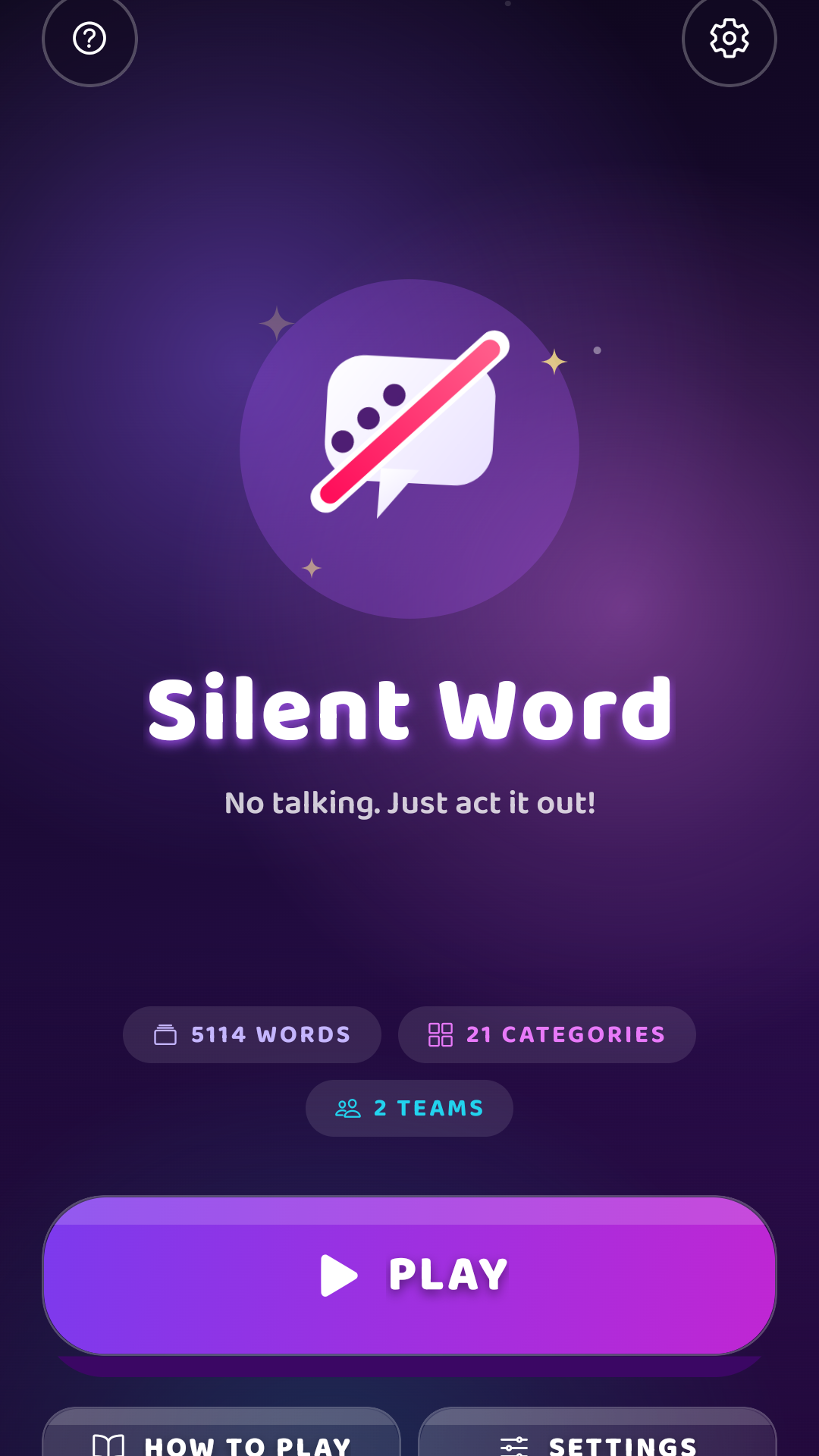
All these tactics sink in with repetition. Since Sessiz Kelime has 20+ categories and adjustable time/pass limits, you can easily train the same group at different difficulty levels: start with a broad category to warm up, then narrow categories with shorter time.
Frequently Asked Questions
What's the difference between Tabu and Sessiz Kelime?
In Tabu you can speak but can't use forbidden words. In Sessiz Kelime you can't speak at all; explanation is done entirely through gesture.
Where should you start when explaining?
With the category. Giving the word type (object, profession, film, animal) from the start is the single move that cuts down guessing time the most.
How does a team guess faster?
By building a shared gesture dictionary and thinking out loud. After two rounds, a well-established sign language lets you finish twice as many words in the same time.

Sessiz Kelime
Two teams, a word explanation race without speaking. 20+ categories.