A Game to Play with Friends at Home When You're Bored

Everyone arrives, tea is brewed, the first half hour of chat is done — and that silence falls. "So, what should we do?" This question isn't about the lack of games, it's about not being able to start one. That difference matters, because that's where the solution is.
The problem isn't the lack of games, it's the setup threshold
There are games at home; board games in the closet, dozens of apps on phones. But opening the box, setting up the pieces, and explaining the rules to six people takes twenty minutes. In those twenty minutes, two people check their phones, one goes to the kitchen, and the game falls apart before it even starts.
That's why the game that works at home isn't the "best game," it's the one that starts fastest . Group energy has a short lifespan; if you spend it on the setup screen, it doesn't come back.
What does a game that starts in 5 minutes look like?
All games that stick in a home setting meet the same four points:
- No setup. You don't need to arrange things on a table, count cards, or search for pen and paper.
- Rules in three sentences. A game with a long explanation dies while being explained.
- Everyone plays in the first round. A person waiting three turns to play checks out of the game.
- Ends whenever you want. A game that feels like "we have to finish this" doesn't get opened a second time.
Why does the dice task format work so well?
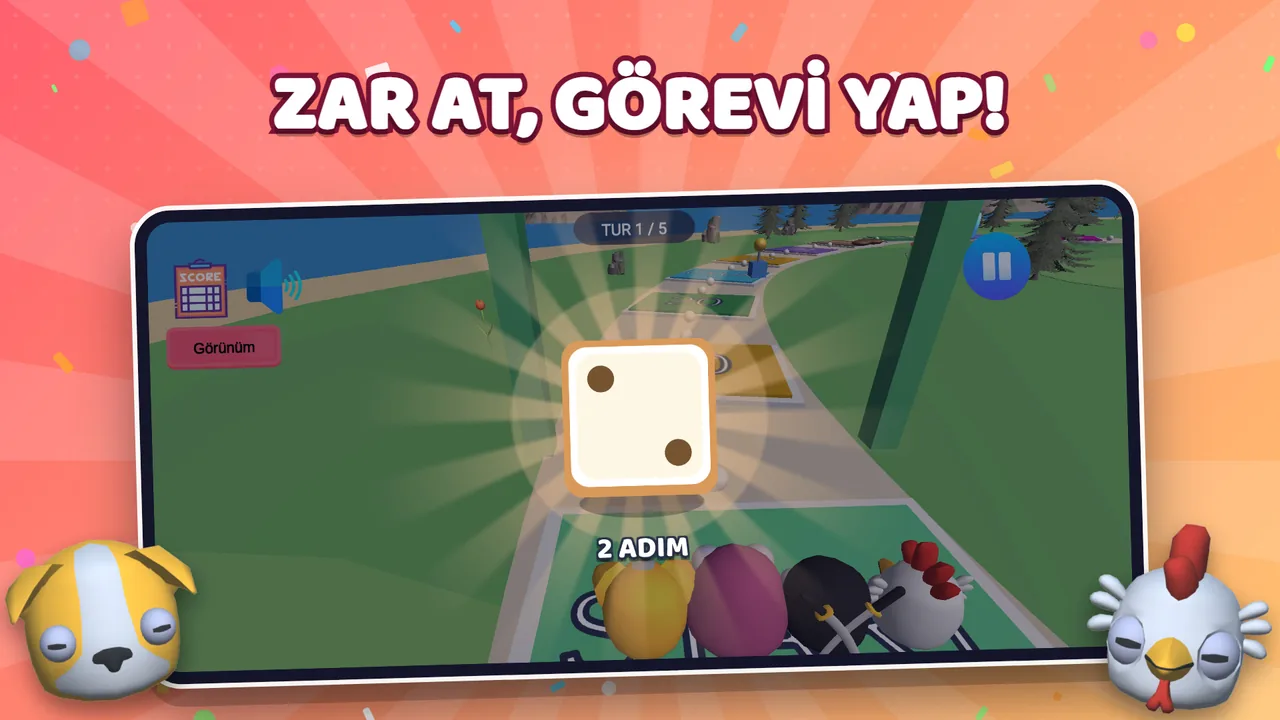
In games played at home, two things get stuck constantly: whose turn it is and what to do. Dice task games eliminate both.
- Dice end debate. No question of "whose turn is it"; the dice say, no one favors anyone.
- The task card lifts the creative burden. No one has to come up with something funny right then — that's the hardest part, and the game handles it.
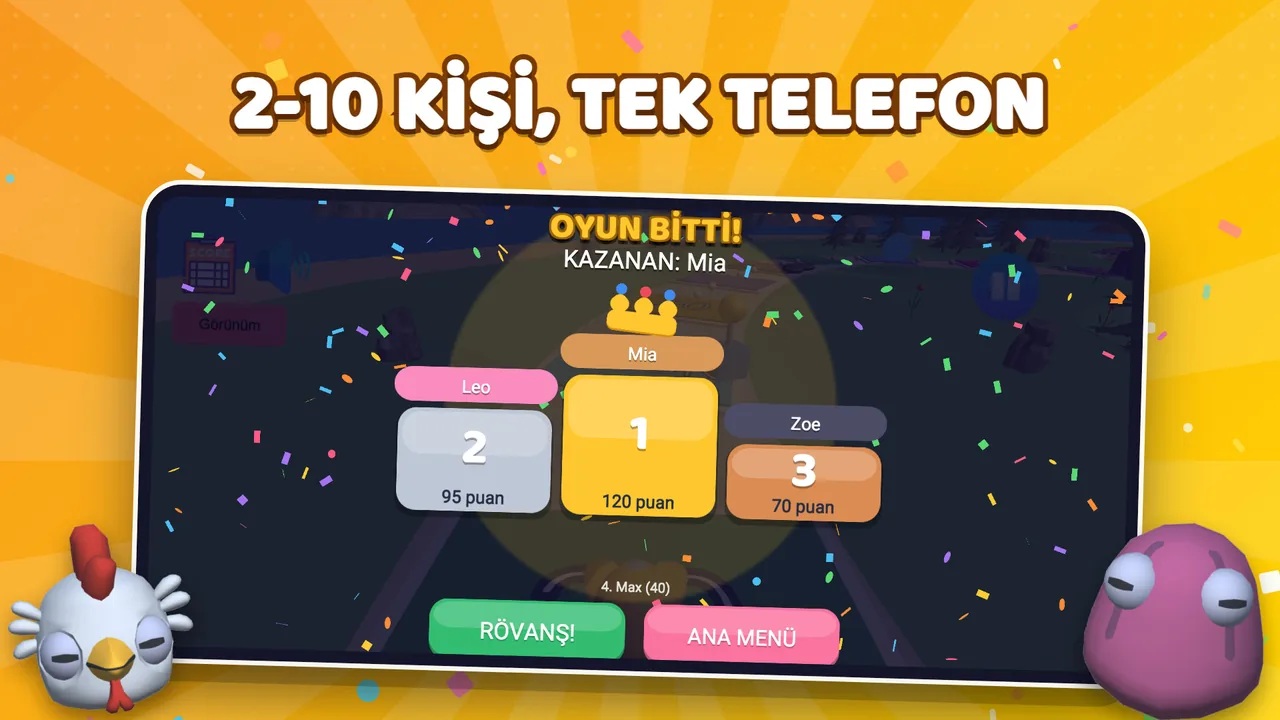
- Scoring gives a reason to keep going. A game without a score loses seriousness by the second round.
- The board gives a sense of progress. A piece moving down the board shows the game is going somewhere; the finish line is visible.
How many of you are there? The setup changes with it
The same game should be played with different setups depending on group size. The most common mistake is starting the same way with every group.
- 2–3 people: Pace is already high, increase the number of rounds. Task variety will feel low, so open the Party category from the start.
- 4–6 people: The most balanced range. Play with default settings, no need to change anything.
- 7–10 people: Gaps between rounds get longer. Lower the number of rounds so the game ends in 25 minutes; if it drags, half become spectators. Team mode (Red–Blue) keeps everyone in the game in a crowd.
- Mixed ages / family: Keep only the Family category open; turn off Party and Dare (18+) tasks.
Three moves that save the first ten minutes
- Start with an easy task. If the night's first task feels hard, the group shuts down and never opens again.
- Give pass rights. Everyone gets one pass. A person struggling skips a turn instead of checking out of the game.
- Read the score out loud. A group hearing who's ahead keeps playing in the second half.
If boredom creeps back
Stretching a single game is the fastest route to boredom. The moment pace drops, end the round and either change the settings or switch to a different mode. The same group, playing three different 20-minute games, has a better time than one 60-minute game.
Practical measure: if no one laughed in two rounds straight, the game is done—don't stretch it.
For people who want to play right away
Roll or Dare was made for exactly this need: enter names, pick a category, roll the dice, do the task on screen. No setup, no rule explanation; timing, score, and turn tracking are built in. Works with 2 to 10 players, you choose how many rounds; over 1000 tasks, Adventure Island, monsters, and mini-games are ready to go — so the jump from "what should we do" to gaming takes five minutes.
Frequently Asked Questions
What can we play at home when we're bored?
Games that need no setup, explain in three sentences, and have everyone playing in the first round give the best results. Dice task games meet all of this, so they're the type that sticks best in a home setting.
Can you play with 3 people?
Yes. Works from 2 players on; with few people the pace is high, so increasing round count a bit saves it from ending too fast.
Does it need supplies or preparation?
No. One phone is enough; no cards, paper, pen, or box needed. After entering names, you roll right away.

Roll or Dare: Party Board Game
Roll the dice, do the task! 1000+ tasks, Adventure Island, monsters, mini-games, and a Destiny Spinner. 2–10 person party game on one phone.