How to Play Backgammon? All Rules and Details From Start to Finish
Backgammon, with its history spanning over 5,000 years, is one of the oldest board games in the world. In this guide, we've prepared for anyone who wants to learn this game from scratch, combining chance and strategy between two players—from the board to the rules, from strategy to backgammon variants, you'll find everything here.
Want to play backgammon right now? Practicing while reading the rules accelerates learning. You can play for free from your browser with SogeGammon.
Play Now →What is Backgammon?
Backgammon is a dice and strategy game played between two people. Each player has 15 pieces; the goal is to move these pieces in a certain direction on the board, bring them to your home board, and remove them by bearing off. The player who bears off all their pieces first wins the game.
The game involves both chance (dice) and skill (choosing moves). In the short term, dice results can be decisive, but in the long term, the player making the right decisions always comes out ahead.
The Backgammon Board
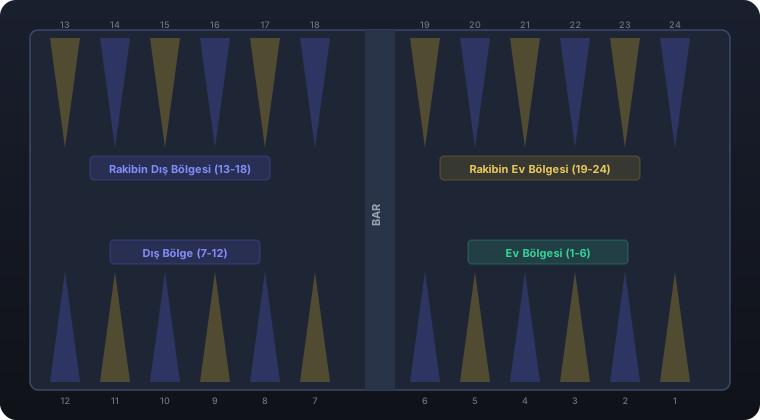
A standard backgammon board is rectangular and folds in half at the center. Each half of the board has 12 points, for a total of 24 sharp triangles (points) in all. These triangles are painted alternately in two colors. The board is divided in half by a bar (a strip) in the middle.
The points are numbered 1 to 24. The numbering is reversed for each player: your point 1 is your opponent's point 24.
Board Sections
- Home board (inner board): Your points 1-6. You need to bring your pieces here.
- Outer board (outer area): Your points 7-12.
- Opponent's outer board: Points 13-18.
- Opponent's home board: Points 19-24. Your pieces start here and move toward your home.
- Bar (strip): The divider in the middle of the board. Hit pieces are placed here.
Starting Setup
Before play begins, both players place their pieces on specific points. The standard setup is the same for each player:
- 2 pieces — on point 24 (the farthest point of the opponent's home board)
- 5 pieces — on point 13 (the beginning of the opponent's outer board)
- 3 pieces — on point 8 (your outer board)
- 5 pieces — on point 6 (the farthest point of your home board)
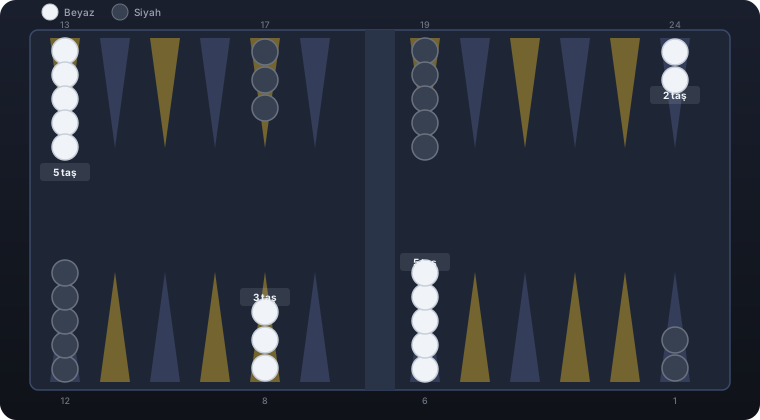
This setup creates a symmetric structure; both players' pieces are placed as mirror images. For a detailed diagrammed explanation of the setup, see our Backgammon Setup: How to Arrange the Pieces? article.
The Objective of the Game
Each player's sole objective is to bear off all 15 pieces before their opponent. To do this, you must complete three stages:
- Movement: Move your pieces toward your home board according to the dice results.
- Getting home: Bring all 15 of your pieces to your home board (points 1-6).
- Bearing off: Once all pieces are home, remove them from the board using the dice.
Who Starts the Game?
To determine who goes first, each player rolls one die. The player rolling the higher number starts. If tied, the dice are rolled again. The starting player makes their first move using the numbers shown on both dice (their own die and their opponent's die). From subsequent turns onward, each player rolls both dice at once.
Dice Rolling Rules
Players alternate rolling two dice. The numbers shown on the dice are used separately. For example, if you roll a 3 and a 5, you can move one piece 3 points and another piece 5 points; or you can move the same piece 3 points first and then 5 points (or 5 then 3) for a total of 8 points.
Doubles (dubla)
If both dice show the same number, this is called doubles. When you roll doubles, the number shown is played four times . For example, if you roll 4-4, you make four separate moves of 4 points each. Doubles provide a powerful advantage because you can make twice the normal moves.
Obligation to Move
You must use both dice (or all four in doubles) if possible. If you can only use one die, you must play the larger die. If you cannot move any pieces, your turn passes.
Moving Pieces
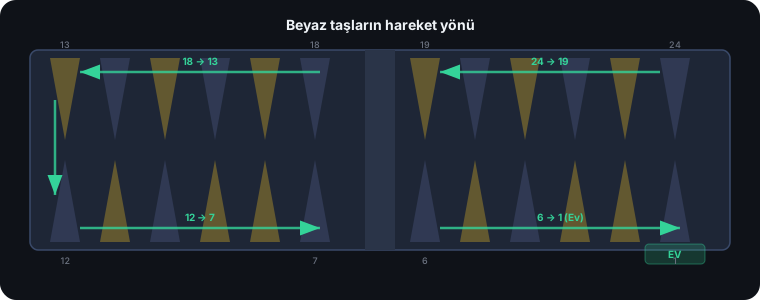
Pieces always move in one direction, from higher-numbered points to lower-numbered points (toward your home board).
Where Can a Piece Be Placed?
A piece can only be placed on:
- An empty point
- A point where your own pieces are (unlimited number of pieces)
- A point where the opponent has only one piece (in this case, the opponent's piece is hit)
You cannot place a piece on a point where your opponent has two or more pieces; that point is closed.
Intermediate Stops
When moving a piece forward by the sum of both dice, the intermediate stop point must also be valid. For example, if you want to move a piece 8 points forward with a 3-5 roll, the piece must be able to temporarily land on a point 3 or 5 points ahead. If both intermediate stops are closed, you cannot make this move.
Hitting (Striking)
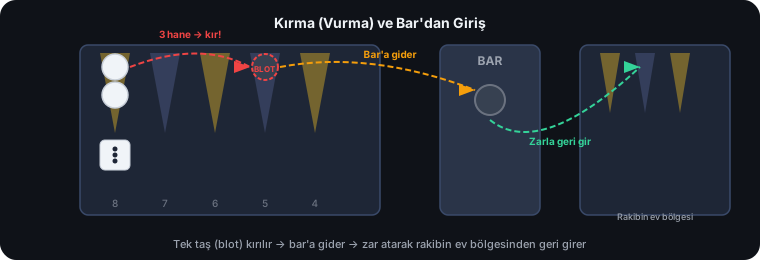
An opponent's single piece standing alone is called a blot . If you place your piece on a point with a blot, you hitthe opponent's piece. The hit piece is placed on the bar in the middle of the board, and on the opponent's next turn, they must first re-enter that piece into play.
Hitting is one of backgammon's most powerful tactical tools. Sending your opponent's piece backward both slows them down and gives you a chance to close your home board.
Entering From the Bar (Re-entering Play)
A player with a piece on the bar must re-enter that piece before making any other move. The piece is entered into the opponent's home board (points 24-19) according to the dice result.
- If the die shows 3, the piece can be placed on point 3 in the opponent's home board (your point 22).
- This point must be either empty or contain one of your pieces.
- You cannot enter a point closed with two or more of your opponent's pieces.
If your opponent has closed all six points (a full blockade), the piece on the bar cannot enter at all, and your entire turn is passed. You cannot play until your opponent opens a point.
Bringing Pieces to Your Home Board
To bear off your pieces, all 15 of your pieces must be in your home board (points 1-6). If you have even one piece on the bar or outside your home board, you cannot start bearing off.
During the process of getting home, interaction with your opponent's pieces continues. If your piece is hit, bearing off stops; you must remove the hit piece from the bar and get it back home again.
Bearing Off
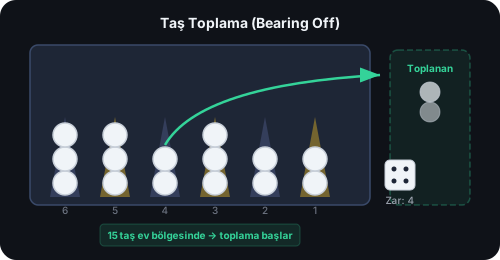
Once all your pieces are in your home board, you proceed to the bearing off stage. On each dice roll:
- You remove from the board a piece from the point shown on the die. For example, if you roll a 4, you bear off one piece from point 4.
- If there is no piece on the point shown, you must move forward a piece from a higher point normally.
- If there is no piece on the point shown and there are also no pieces on higher points, you can bear off a piece from the highest point.
If your piece is hit during bearing off, you must remove that piece from the bar, get it back home, and only then continue bearing off.
Game End: Types of Wins
The player who bears off all their pieces first wins. There are three different types of wins:
- Normal win: If your opponent has already started bearing off (removed at least one piece), you win 1 point.
- Gammon: If you finish before your opponent bears off any pieces, you win 2 points .
- Backgammon (Double gammon): If your opponent hasn't borne off any pieces and also has at least one piece still on the bar or in your home board, you win 3 points .
Doubling Cube
The doubling cube, used in tournaments and serious matches, is used to increase the stakes of the game. The cube has the numbers 2, 4, 8, 16, 32, and 64 on its faces; the initial stake is 1.
How Does It Work?
- When it's your turn, before rolling the dice you can offer doubles to your opponent. This means doubling the stakes.
- If your opponent accepts, the stake doubles and the doubling cube now passes to your opponent's side. Only they can offer the next double.
- If your opponent refuses, they lose the game at the current stake value (meaning 1 point before the offer).
The doubling cube greatly increases the strategic depth of the game. When your position is strong, offering doubles puts your opponent in a difficult decision: do they continue and take double the risk, or accept the current loss and move on to a new game?
Backgammon Variants
Standard backgammon (also known as long backgammon) is the most common version, but different variations are also played:
Short Backgammon (Moultezim / Plakoto)
In this version played in some regions, pieces move in one direction, and instead of opposite home boards, pieces are borne off from the same side. Rules vary from region to region.
Gul Bara
A variant played in Turkish backgammon tradition. Both players move their pieces in the same direction (counterclockwise). There is no hitting; instead, both your pieces and your opponent's pieces can be on the same point, and the opponent's piece is "locked," meaning it cannot move.
Narde
Narde, common in the Middle East and Central Asia, is similar to Gul Bara: pieces move in the same direction and there is no hitting.
Acey-deucey
A variant that originated in the U.S. Navy. Special rules come into play when 1-2 is rolled.
Basic Strategy Tips
If you're new to backgammon, the following tips will immediately raise your winning percentage:
- Avoid leaving single pieces (blots): Whenever possible, keep at least two pieces on each point. Leaving a single piece is a hitting risk.
- Close points: Especially closing consecutive points in your home board makes it harder for your opponent's bar piece to re-enter.
- Close the 5-point: Known as the "golden point," this is the single most valuable point in backgammon. Closing it early provides a major advantage.
- Don't spread pieces too thin, but don't pile them up either: Having 6-7 pieces on a single point is wasteful; distributing them across several points gives you more options.
- When ahead, run; when behind, look for contact: If you're ahead in the race, reduce contact and bear off quickly. If you're behind, look for opportunities to block your opponent and hit.
- Learn to read the dice: There are 36 possible outcomes with two dice. Knowing which distances are likely to be hit helps strengthen your risk calculation.
For more detailed strategy information, read our Winning Strategies in Backgammon: 7 Rules for Beginners article.
Playing Backgammon Online
The fastest way to learn backgammon is through practice. Even without a backgammon board or opponent nearby, you can play online.
SogeGammon lets you play live backgammon against real opponents without chip worries. You can go to gammon.tr from your browser and sit down at a table right away. Choose your match format (1 point, 5 points, or 10 points), test yourself in ranked ratings, and participate in tournaments.
You've learned the rules, now it's time to practice! Play backgammon for free on SogeGammon. No chips, no waiting, just backgammon.
Play Now →Frequently Asked Questions
How many pieces are in backgammon?
Each player has 15 pieces, for a total of 30 pieces. The pieces are in two different colors.
Who starts first in backgammon?
Each player rolls one die; the player rolling higher starts and makes their first move using the two separate dice numbers shown, not the sum of the two dice.
How many moves when rolling doubles?
When you roll doubles, the number shown is played four times. For example, if you roll 3-3, you make four separate moves of 3 points each.
What is gammon and backgammon?
Gammon: Finishing the game before your opponent bears off any pieces; it gives twice the points of a normal win. Backgammon: If one of your opponent's pieces that hasn't been borne off is still in your home board or on the bar, you win three times the points.
Can I play backgammon online?
Yes. With SogeGammon you can play backgammon right from your browser: go to gammon.tr, play against real opponents without chip worries.

SogeGammon
Chipless online backgammon: live opponents, free tournaments, ranked ratings. Play now on gammon.tr or wait for our mobile app.